
Helen Zille at Craighall Primary School: key issues raised by residents
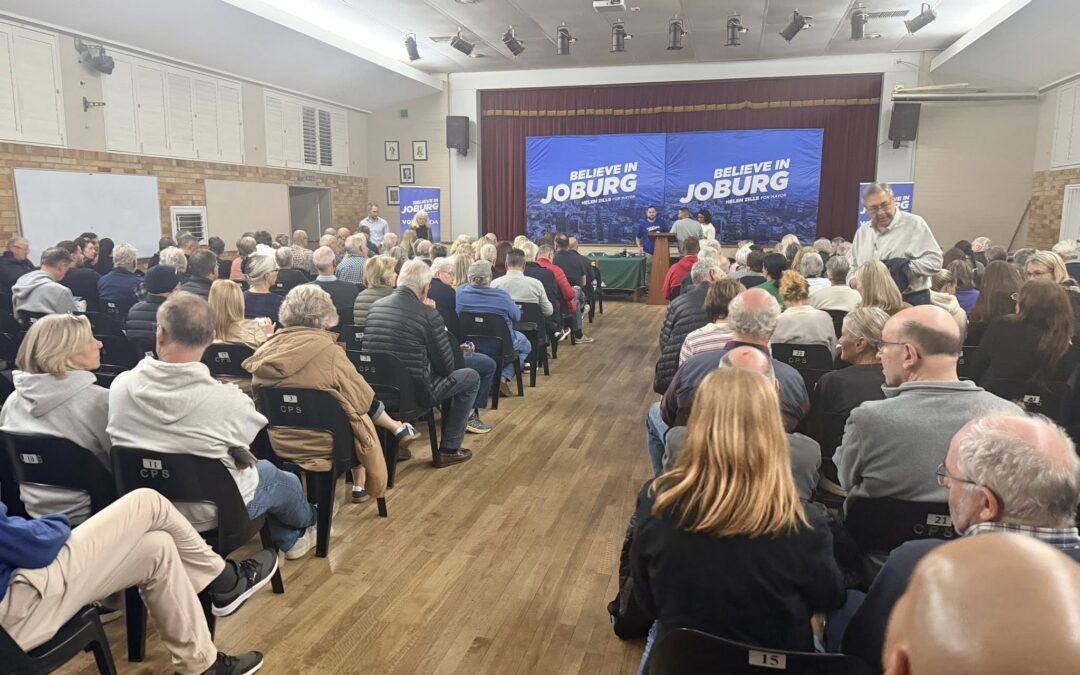
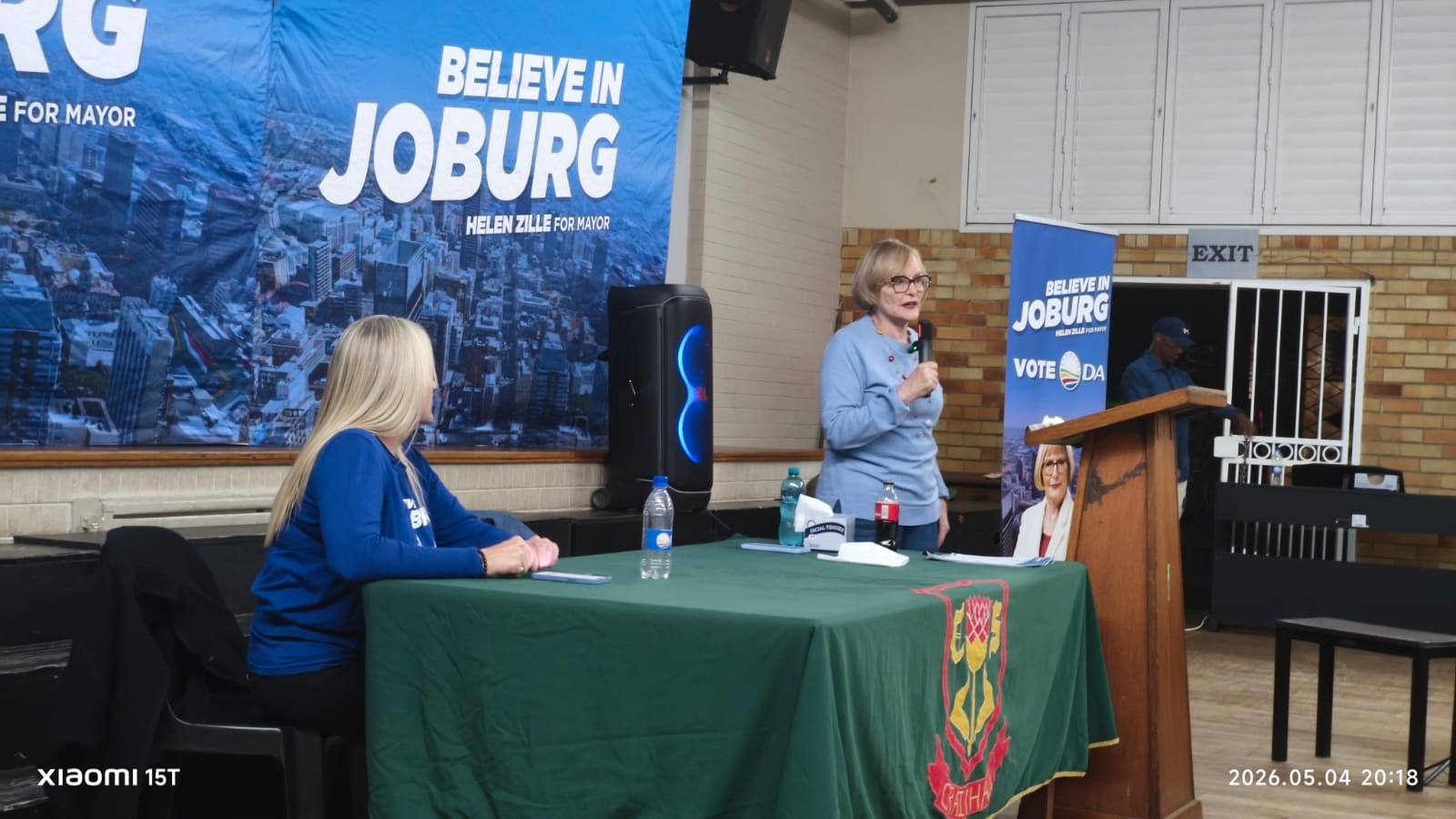
On Monday, 4 May 2026, residents, ratepayers and community representatives gathered at Craighall Primary School for a public engagement with Helen Zille for Ward 90 in the City of Johannesburg. The meeting was structured less as a formal speech and more as a community “job interview”, with Zille giving introductory remarks before taking questions from residents.
While the event was political in nature, the discussion focused heavily on issues familiar to residents across Johannesburg: service delivery, municipal finances, roads, electricity, water, green spaces, public safety, corruption, and the role of active communities in holding local government to account.
Opening remarks: turnout, coalitions and the state of Johannesburg
Zille opened by acknowledging the strong turnout and the role of ratepayers’ associations in civic life. A central theme of her introduction was that local government outcomes are shaped by voter participation, and that apathy in areas with high numbers of registered voters can have a material effect on the composition and stability of council.
She explained the local government voting system, including the ward and proportional representation ballots, and argued that turnout in traditionally high-support areas can affect not only ward outcomes but also the number of proportional representation seats allocated in council. She linked this to the broader problem of unstable coalitions, saying that fragmented results can make it difficult for any administration to maintain continuity, pass budgets, or implement long-term programmes.
A major part of her opening remarks dealt with Johannesburg’s finances. Zille described the City’s position as highly constrained, referring to budget pressures, debt, concerns around the City’s ability to raise capital, the capital budget, and the state of entities such as City Power and Johannesburg Water. Her view was that infrastructure failure is now the result of years of under-maintenance, weak financial management and insufficient reinvestment in core services.
She also stressed that any plan to improve Johannesburg would need to be backed by a credible budget, not simply promises. In her framing, the central municipal challenge is to stabilise finances, prioritise essential services, restore maintenance, and improve governance.
Green spaces and densification
The first part of the Q&A dealt with green spaces and development pressure. Zille said that Johannesburg cannot simply continue to sprawl indefinitely, and that some densification is inevitable. However, she emphasised that higher-density urban living makes properly maintained public open spaces even more important.
Her response was that parks and green spaces should be protected, upgraded, made safe and actively used. She referred to examples where community involvement and public-private partnerships had helped keep parks functional, clean and accessible. The broader point was that densification should not come at the cost of public open space; rather, working parks become more important as the city grows.
Electricity outages, reporting systems and communication
Residents raised concerns about repeated power outages and weak communication from City Power. Zille’s answer was that City Power and Johannesburg Water are overwhelmed by infrastructure failure, shortages of spares, and weak operational systems. She also criticised the practice of service tickets being closed before problems are properly resolved.
Her proposed solution was more decentralised service communication, including a call centre or reporting function linked to each depot, so that local depots can deal directly with the areas they serve. Ward councillor Renata Van Onselen also indicated that ward-level communication had been taking place, but acknowledged that messages can break down where information moves through multiple community groups.
What to do with a financially distressed city
A resident asked what Zille would do if elected to lead a city facing severe financial strain. Her first answer was ring-fencing: money collected for core services such as water, electricity and possibly refuse removal should primarily be used to maintain and improve those services.
She also discussed keeping solar users connected to the grid where possible, allowing surplus electricity to be fed back into the municipal system, and using that structure to support the broader grid. She referred to possible national support for utility renewal and said public-private partnerships could play an important role where there is a clear revenue stream, such as water, electricity and refuse.
Roads, potholes, taxis and municipal entities
Residents asked about the state of roads, the taxi industry as a stakeholder, the governance of municipal entities, skills audits, and first priorities.
On roads, Zille said the City would need to take an inventory, prioritise the worst routes, and work through them systematically. She also supported trained and certified community participation in dealing with smaller surface potholes, while leaving deeper structural road failures and full resurfacing to formal prioritised programmes. Taxi operators, she said, are also affected by poor roads and could potentially form part of broader stakeholder engagement.
On municipal entities, her view was that the entities should not necessarily be scrapped, but their boards and governance need serious attention. She argued that boards should be properly skilled and less politically captured, with stronger professional oversight.
On skills and accountability, she supported targeted skills audits, lifestyle audits for senior and procurement-related positions, external forensic oversight, greater scrutiny of bid evaluation processes, and practical measures to identify ghost workers or non-performing staff.
She summarised five broad priorities: reliable water and electricity, roads that work, renewed investment and job creation, tackling corruption and improving law and order, and building a professional modern city administration. She cautioned that these were five-year objectives, not quick fixes.
Property, expropriation and derelict buildings
Questions were also raised about expropriation and property rights. Zille said the issue was being challenged through legal and political channels and argued that secure property rights are essential to a functioning economy.
In relation to derelict buildings, she suggested that the City should look more seriously at sales in execution where buildings owe large amounts to the municipality and are not being properly maintained or paid for. Her emphasis was on recovering value for the City while dealing with problem properties through lawful processes.
Younger voters and voter apathy
A younger resident asked about voter apathy among Gen Z and why many younger voters are attracted to smaller parties that present themselves as more progressive.
Zille’s answer was that younger voters need to be engaged on evidence, outcomes and the practical meaning of “progress”. She argued that job creation, working infrastructure, functioning public transport, tourism, safety and access to opportunity should be treated as progressive outcomes. Her broader point was that youth engagement should focus on real-world consequences rather than slogans.
Immigration, homelessness and Delta Park
Immigration and people living in Delta Park were raised more than once. Zille distinguished between people who are lawfully in South Africa, people with scarce skills, asylum seekers, and people who are in the country unlawfully.
On Delta Park specifically, she acknowledged the difficulty and humanity of the situation. She noted that some people living there may work in the area but be unable to afford daily transport from where they live. Her view was that the City needs fair and humane solutions, while also enforcing the law where people are unlawfully in the country or unlawfully occupying public land.
Cape Town comparisons, workers and unions
A resident challenged direct comparisons between Cape Town and Johannesburg. Zille accepted that Johannesburg and Cape Town are not the same, noting that Cape Town has had a longer period of stable government, was not as financially distressed when the DA first took over, and retained a stronger core of professional public servants.
She said that Johannesburg would require a long-term turnaround, not instant transformation. On municipal workers and unions, she said she supports the right of unions to exist and represent workers, but that wage agreements and working practices must remain within what the City can afford. Her emphasis was on fair pay for honest work, coupled with accountability and productivity.
Public safety, JMPD and by-law enforcement
A resident asked about Metro Police visibility and response times in residential suburbs. Zille said this was not her specialist area, but that the JMPD should be better trained, better led and more focused on its municipal mandate.
She emphasised that Metro Police are not the same as SAPS and cannot investigate crime in the same way. However, they can play a role in crime prevention and, importantly, in enforcing municipal by-laws. She said by-law enforcement should be a much higher priority, particularly where municipal courts exist but are not being properly used for by-law infringements.
Corruption and procurement
Several answers returned to the theme of corruption. Zille described municipal corruption as systemic and often sophisticated, involving procurement, maintenance contracts, billing, legal recoveries and infrastructure components.
Her proposed approach was to understand precisely how corrupt systems operate, then design controls, forensic processes and oversight mechanisms to disrupt them. She also referred to the importance of whistleblowers, forensic auditors, accountants and experienced professionals assisting in identifying how schemes work.
Skills, investment and economic activity
Towards the end of the meeting, Zille was asked about skilled immigration and investment. She said she supported scarce-skills visas, digital nomads and investment-linked migration where people bring skills, capital, spending power or job creation into the economy. At the same time, she said South Africa cannot have an open-border approach that places additional pressure on a small tax base.
Closing theme: active citizenship
A recurring theme throughout the evening was the role of active residents. Zille repeatedly referred to Johannesburg’s “can-do” communities and the value of residents who already work to maintain parks, report outages, fix local problems, and organise through residents’ associations.
For CRA and neighbouring communities, the evening was a useful opportunity to hear how a prospective mayoral candidate framed Johannesburg’s challenges and to put local concerns directly on the table. Whatever residents’ political views, the issues raised — infrastructure, finances, public space, safety, service communication and accountability — remain central to the future of our suburbs and the City as a whole.